- 132 pages
- English
- ePUB (mobile friendly)
- Available on iOS & Android
eBook - ePub
About this book
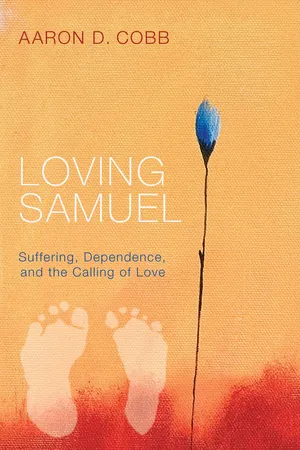
Loving Samuel is a retelling of the experience of welcoming and loving my son Samuel, who was diagnosed in utero with a chromosomal abnormality known as Trisomy 18. Samuel died January 2, 2012, just five hours after his birth. The experience of loving him and grieving his loss has profoundly shaped the character of my family. Loving Samuel weaves together both the narrative of our experience and broad thematic reflections on the human condition, the difficulties of loss and grief, the importance of friendship, and the necessity of virtues like faith and love for suffering well--for wresting something good from circumstances that seem meaningless.
Trusted by 375,005 students
Access to over 1.5 million titles for a fair monthly price.
Study more efficiently using our study tools.
Information
1
Samuel

How does one remember a life that ends before it begins? How can one offer a good word about a life whose every moment was coded for death? Is it all a waste? And when I consider Samuel—his life—is it a waste for him? Would Samuel have been better off having not experienced his mom’s love? Is his brother’s love and laughter wasted? Are my words insignificant to his little life?
November 13, 2011
Samuel was born New Year’s day. He had lived just four hours and fifty-eight minutes when his nurse quietly whispered, “I don’t hear a heartbeat.” I kissed his head gently. Those brief hours with him were some of the most important of my life; they were at once peaceful, sad, and significant. Holding Samuel was an unexpected gift, a tender touch of mercy at the end of a difficult journey.
Nearly five months earlier, there were indications of an abdominal wall defect known as an omphalocele. During his development, the muscles in Sam’s abdominal wall did not close properly, leaving a large segment of his intestines, his liver, and his spleen enclosed within a thin layer of tissue on the outside of his abdomen. Later ultrasounds would confirm this reading and signal a constellation of other defects: clubbed feet, clenched fists, a hole in the wall between the upper chambers of the heart, a head with prominent occiput (or, as the physician described it, “a strawberry-shaped head”).
I remember the first time we heard this long litany. I remember the physician’s demeanor: her initial warmth and openness quickly gave way to a kind of mechanical clinicalism. She was thorough and she became distressingly quiet. When she had finished, she rolled her chair back, removed her gloves, and spoke hesitantly: “I’m afraid I don’t have good news.” Pausing briefly, she continued, “I’m seeing defects beyond what we already knew were present.” Reciting the lengthy list of concerns articulated above, she concluded, “I think that these are all consistent with a chromosomal abnormality called Trisomy 18.” Pausing just long enough to sense a question, she added, “This is a lethal chromosomal abnormality. You son will probably not make it to birth and if he does, there is a 90 percent chance that he won’t live past his first year of life.”
We received this news in late September, a little over three months before Sam was born. That night, I wrote this brief note to family and friends:
His name is Samuel Irvin Cobb. We love him fiercely and hope to bring him home. He has Trisomy 18, a constellation of associated defects, and a bleak prognosis. We chose the name Samuel because Micah asked to read the story of Hannah and Samuel from his Bible last night. This story is deep with significance for us today. Irvin was my dad’s name—a good name and an honorable man. We are breathing. We find great comfort in the many family and friends who have shown their concern and who are lifting us up in prayer.
Over the five months in which we knew that our son had specific defects, and the three-and-a-half months in which we knew that he had Trisomy 18, my wife gracefully endured a difficult pregnancy knowing that, in all likelihood, her child would be stillborn or die shortly after birth. The pregnancy was made even more difficult by the inquiries, idle comments, and congratulations many, including complete strangers, offer to those who are obviously pregnant. I can comprehend only a small part of what it was like for her to love and carry Samuel as she did.
This book is an outworking of the many questions and thoughts we discussed in the course of those months of pregnancy and the months that have followed as we have been grieving the loss of our son. It is a re-telling of our experience—a picture of our halting attempts to grasp this experience and to live out the beliefs to which we have committed our lives. I write to keep alive the memory of my precious son whom I love and miss dearly. I write as an exercise of faith. And what I write, I offer as a small sign of gratitude for the gift of my son.
2
Beginning
We had been told that Samuel’s life was too fragile to live long. We had been told that Samuel’s body was irreparably broken. We had been told that Samuel would likely die, that his was a life “incompatible with life.” Sam’s life was gone even before his life began. We had already lost him; our best wish was for a peaceful death. We were offered an interruption, an escape. Instead, she chose to bear a child whom she would hold, lifeless, in her arms. And she welcomed him.
August 9, 2012
We first learned that Alisha was pregnant near the end of May. This was our third pregnancy; just seven months earlier, Alisha had suffered a miscarriage. On this side of that loss, our excitement about Samuel was equaled by our anxiety. The early stages of pregnancy did nothing to ease these fears and we spent much of the first trimester failing at our attempts not to worry. We began the second trimester far from home. After a long day’s drive, Alisha began experiencing what she believed were signs of miscarriage. We hurried to the emergency room, expecting to have our fears confirmed. After a long wait, we were relieved to see and hear Sam’s heart tones on the ultrasound monitor.
The relief we felt would be temporary. The next day, we received a message that a radiologist at the hospital had read our ultrasound and believed that there were signs indicative of an omphalocele. Patiently, the emergency room nurse spelled the word for us and told us to contact Alisha’s obstetrician so that we could schedule a follow-up visit when we returned home. She encouraged us not to be anxious. “If it is an omphalocele,” she said, “in most cases, it can be corrected surgically.” Almost before Alisha had hung up the phone, I began my research. Attempting to navigate through the confusion I was already experiencing, I needed to understand what we were facing and what questions to ask.
Our visit to Alisha’s obstetrician a week later confirmed the radiologist’s initial reading and we were told that we needed to schedule a visit for a level-two ultrasound with the specialists in Fetal and Maternal Health. This was routine procedure; the physicians would need to search for any associated anomalies as part of the process of planning for Samuel’s birth. We jumped at the earliest opportunity for an appointment and, just three weeks later, we watched the ultrasound monitor in a darkened examination room as the specialist began his meticulous search. Alisha’s abdomen became an experimental space for his investigation. Throughout the ultrasound, the physician spoke with the young resident who was observing his work and rarely acknowledged our presence in the room. He was methodical, using our appointment as an opportunity for instruction, employing language that only he and the other professionals in the room would understand. (I made mental notes of terms I would look up when we returned home.)
After twenty minutes of probing, he stopped the exam almost abruptly and turned to us—it seemed, for the first time. He informed us that he was attempting to see whether there were any indicators of associated defects and, in particular, markers indicative of chromosomal abnormalities. But, he said almost accusingly, this visit was poorly scheduled. Either the fetus was too small because it was too early in the pregnancy or it was not positioned in such a way that he could make definitive claims one way or another. “If there are chromosomal abnormalities,” he asked, “would you consider interrupting the pregnancy?” We answered, “No.” And we did not correct his failed attempt at euphemism. After scheduling a second appointment, we drove home frustrated that we didn’t know the extent of our son’s difficulties. This frustration was compounded by the anger I felt toward the specialist.
It was during our next visit four weeks later that a separate physician was able to detect the full range of Sam’s defects. We were again asked whether terminating the pregnancy was an option. We declined. But we agreed to an amniocentesis so that we could develop a plan of action for how best to care for Sam if he made it to birth. If Sam did not have Trisomy 18, we would need to think through what we would need to do to stabilize his body and how best to proceed with the necessary corrective surgeries when his body could withstand these interventions. The physician informed us that, given the size of the omphalocele, it was unlikely that his body would be able to withstand corrective surgery. In fact, she assured us that she would not recommend surgery in his case given the magnitude of the omphalocele and the deleterious effects this size of omphalocele would have on his respiratory function. There was nothing she could do for him or for us.
If Sam did have Trisomy 18, given the wide array of defects presenting in the ultrasound findings, we would need to consider the kind of care he ought to receive should he make it to birth. The physician again informed us that it was not likely that he would make it to live birth. Nonetheless, we decided that it would be best to know so that we could be prepared for whatever contingencies we might face.
And then we drove the ninety minutes home, most of the time in silence or in tears, at times attempting to discuss what we would endure in the months ahead. When it was quiet, I tried to pray. And in my attempts, I remember hoping that God would protect my wife from the inevitable uncomforting words we were likely to hear.
When we arrived home, I faced the difficult task of relaying our news to family and friends. More difficult than these phone calls was finding a way to tell our four-year-old son, Micah, who was, by now, very excited about being a big brother. I told him that we had been to see a doctor about Sam and showed him the new ultrasound pictures a nurse had handed to us as we walked out of the appointment. I told him that we had received some sad news; he was more interested in looking at Sam’s pictures. We talked about the pictures and Micah started telling me about all of the things he would do with Sam when we brought him home from the hospital. I knew I needed to say something to begin preparing Micah for a different set of possible outcomes. So, I said to him, “Micah, the doctors told us today that Sam’s body is really sick and it can’t get better. We really want to bring him home but the doctors told us that he might not get to come home with us.” Lying in his bed, Micah began to cry; I held him and cried with him. I kissed his forehead gently.
It had been a miserable, long, awful day—the first of many.
3
Advent Reflection
Annunciation—a sign. Even when that to which it points is unwelcome, it can be a grace. Whether it becomes a grace depends, in part, upon whether we posse...
Table of contents
- Title Page
- Preface
- Acknowledgments
- Chapter 1: Samuel
- Chapter 2: Beginning
- Chapter 3: Advent Reflection
- Chapter 4: Waiting
- Chapter 5: Love's Choice
- Chapter 6: Even If
- Chapter 7: Choosing Suffering
- Chapter 8: Meaning
- Chapter 9: Imago Dei
- Chapter 10: Life
- Chapter 11: With
- Chapter 12: Dependence
- Chapter 13: After
- Chapter 14: Eulogy
- Chapter 15: Grief - Missing the Weight of Him
- Chapter 16: Trust
- Chapter 17: Grief - Lenten Reflections
- Chapter 18: Grief - Unbearable
- Chapter 19: Grief - Distraction
- Chapter 20: Grief - Loss
- Chapter 21: Weak
- Chapter 22: Grief - I Weep
- Chapter 23: Courage and Hope
- Chapter 24: Grief - Irreparable
- Chapter 25: Grief - Drawn Close
- Chapter 26: Grief - Limp
- Chapter 27: Love's Calling
- Afterword
Frequently asked questions
Yes, you can cancel anytime from the Subscription tab in your account settings on the Perlego website. Your subscription will stay active until the end of your current billing period. Learn how to cancel your subscription
No, books cannot be downloaded as external files, such as PDFs, for use outside of Perlego. However, you can download books within the Perlego app for offline reading on mobile or tablet. Learn how to download books offline
Perlego offers two plans: Essential and Complete
- Essential is ideal for learners and professionals who enjoy exploring a wide range of subjects. Access the Essential Library with 800,000+ trusted titles and best-sellers across business, personal growth, and the humanities. Includes unlimited reading time and Standard Read Aloud voice.
- Complete: Perfect for advanced learners and researchers needing full, unrestricted access. Unlock 1.5M+ books across hundreds of subjects, including academic and specialized titles. The Complete Plan also includes advanced features like Premium Read Aloud and Research Assistant.
We are an online textbook subscription service, where you can get access to an entire online library for less than the price of a single book per month. With over 1.5 million books across 990+ topics, we’ve got you covered! Learn about our mission
Look out for the read-aloud symbol on your next book to see if you can listen to it. The read-aloud tool reads text aloud for you, highlighting the text as it is being read. You can pause it, speed it up and slow it down. Learn more about Read Aloud
Yes! You can use the Perlego app on both iOS and Android devices to read anytime, anywhere — even offline. Perfect for commutes or when you’re on the go.
Please note we cannot support devices running on iOS 13 and Android 7 or earlier. Learn more about using the app
Please note we cannot support devices running on iOS 13 and Android 7 or earlier. Learn more about using the app
Yes, you can access Loving Samuel by Aaron D. Cobb in PDF and/or ePUB format, as well as other popular books in Social Sciences & Social Science Biographies. We have over 1.5 million books available in our catalogue for you to explore.